Whey protein has long been a benchmark for high-quality protein formulation. But rising dairy costs, supply volatility, and growing demand for vegan and dairy-free products are pushing manufacturers to rethink their dependence on a single protein source.
For formulators, food scientists, procurement teams, and business leaders, the question is becoming:
Does every high-protein product need to rely entirely on whey?
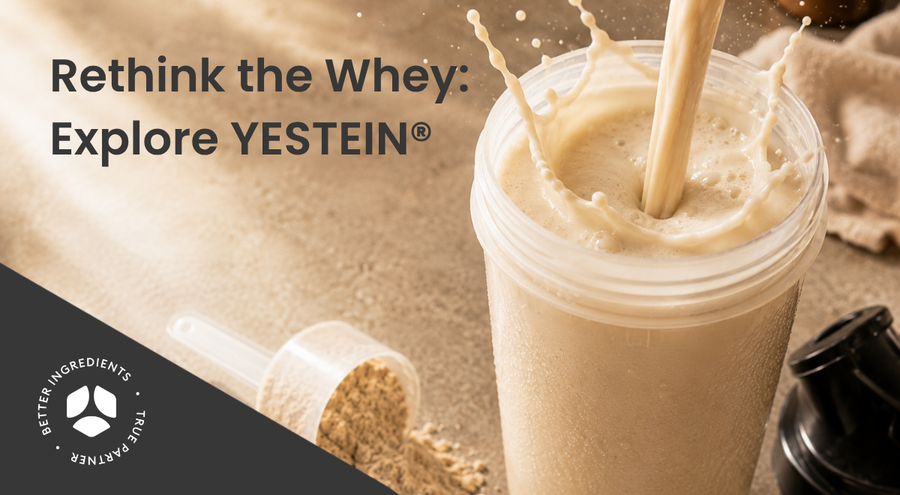
YESTEIN® Yeast Protein provides another option. Brands can use it alongside WPC or WPI as part of a hybrid protein system—or explore eliminating whey all together with a high-quality, fermentation-derived vegan protein.
The opportunity isn’t simply about replacing an ingredient. It’s about creating a more flexible protein strategy that considers nutrition, sensory performance, functionality, cost, and supply.
YESTEIN® is a fermentation-derived vegan protein produced from baker’s yeast (Saccharomyces cerevisiae). Unlike dairy or plant-derived proteins, yeast represents a distinct protein source and gives formulators another approach to high-quality protein nutrition.
The YESTEIN® portfolio offers:
- Complete amino acid profile
- Savory and more neutral flavor profiles
- Clear yeast protein options
- Versatility across food, beverage, and nutrition applications
For R&D teams, YESTEIN® introduces a differentiated fermentation-based protein platform that can complement whey or provide a pathway to move beyond whey entirely.
Two Strategies for a Changing Protein Market
Strategy 1: Optimize Whey with a Hybrid Protein System
For products that don’t need to eliminate dairy, formulators can explore combining YESTEIN® Yeast Protein with WPC or WPI.
Partial substitution can diversify the protein system and potentially reduce exposure to whey price and supply fluctuations while maintaining high-quality protein nutrition.
Rather than simply asking “What can replace whey?”, formulators can consider:
How much whey does this product actually need?
Different YESTEIN®-to-whey ratios can be bench tested to determine the appropriate balance of:
Protein Quality → Sensory Performance → Functionality → Cost-in-Use → Supply Security
The goal isn’t necessarily to eliminate whey. It’s to use whey more strategically.
Strategy 2: Move Beyond Whey with YESTEIN® Yeast Protein
For brands looking to eliminate dairy protein entirely, YESTEIN® provides another pathway.
With its complete amino acid profile and PDCAAS of 1.0, YESTEIN® can be evaluated as the primary protein source for vegan and dairy-free formulations without relying on whey.
This shifts the formulation conversation from simply finding a whey substitute to determining which protein system best delivers the nutrition, sensory experience, functionality, economics, and positioning the finished product requires.
For some products, that may be whey. For others, YESTEIN® + whey. And for others, it may be YESTEIN® without whey at all.
80–90% Protein Options Designed for Different Applications
Different applications call for different protein solutions.
The YESTEIN® line offers approximately 80–90% protein options with different sensory profiles to support varying formulation needs.
More savory profiles can complement food and snack applications, while more neutral options can support applications where minimizing the protein’s impact on the finished flavor is a priority.
This gives R&D teams greater flexibility to match the protein solution to the application.
Yeast Protein Isn’t Limited to Protein Powder
The opportunity for yeast protein extends well beyond traditional protein powders.
YESTEIN® can be explored across a variety of food, beverage, and nutrition formats, including:
RTM Protein Powders • Protein Shakes • Nutrition Bars • Snacks • Gummies • Breads & Baked Goods • Functional Foods • and More
For brands, this versatility creates an opportunity to explore yeast protein across multiple product categories and innovation pipelines rather than limiting it to a single format.
Clear Protein Creates Another Formulation Opportunity
YESTEIN® is also available in a Clear Yeast Protein format, creating opportunities beyond traditional creamy and opaque protein systems.
Clear protein can support the development of lighter, refreshing protein concepts, including functional beverages and other applications where a traditional milky protein experience may not fit the desired product.
For developers, this adds another dimension to YESTEIN® as a versatile protein platform rather than a single-format ingredient.
What Should Formulators Evaluate?
Reducing or replacing whey shouldn’t be treated as a simple one-to-one ingredient substitution.
R&D teams should consider:
Protein Quality • Amino Acid Profile • Solubility & Dispersibility • Flavor • Mouthfeel • Processing • Shelf Stability • Allergen Requirements • Nutrition Targets • Cost-in-Use
For hybrid systems, bench testing different YESTEIN® : whey ratios can help identify the appropriate balance between nutrition, sensory performance, functionality, and economics.
The goal isn’t simply to replace the greatest amount of whey. It’s to build the protein system that makes the most sense for the finished product.
The Business Case Goes Beyond Cost Per Kilogram
For CEOs, procurement teams, and commercial leaders, whey volatility isn’t simply an ingredient-cost issue.
It can influence margins, supply continuity, innovation, and portfolio strategy.
A protein portfolio heavily dependent on one source can leave manufacturers more exposed to changes in pricing or availability. Diversifying protein sourcing gives businesses another way to evaluate and manage that risk while potentially opening new product opportunities.
A YESTEIN® + whey strategy can provide another option for optimizing existing whey-based products, while a fully YESTEIN®-based formulation can support new vegan and dairy-free product platforms.
From Protein Replacement to Protein Optimization
The bigger opportunity with YESTEIN® isn’t simply positioning yeast protein as a replacement for whey.
It’s giving formulators another tool to optimize the entire protein system.
Blend it with whey. Reduce whey. Eliminate whey. Select an 80–90% protein option. Choose a sensory profile suited to the application. Or explore Clear Yeast Protein.
The right strategy depends on the application, nutritional targets, processing requirements, sensory expectations, economics, and desired market positioning.
As the protein market continues to evolve, flexibility in protein sourcing and formulation may become increasingly valuable.
For formulators, scientists, procurement teams, and business leaders, YESTEIN® Yeast Protein provides a fermentation-based platform for developing the next generation of high-protein foods, beverages, and nutrition products.

 Back
Back