Few natural ingredients have a history as remarkable as Shilajit. Formed over thousands of years within high-altitude mountain ranges, this mineral-rich resin has been prized for centuries in Ayurvedic medicine as a rasayana, or rejuvenative tonic. Today, modern research is helping explain why Shilajit has remained one of the world’s most respected wellness ingredients.
Collected primarily from the Himalayan Mountains and purified before use, Shilajit contains a unique combination of fulvic acid, humic substances, dibenzo-α-pyrones (DBPs), and naturally occurring trace minerals. Modern research has investigated its role in healthy mitochondrial function, cellular energy production through ATP pathways, antioxidant defense, reproductive vitality, musculoskeletal wellness, and healthy aging.
A Unique Ingredient with Ancient Roots
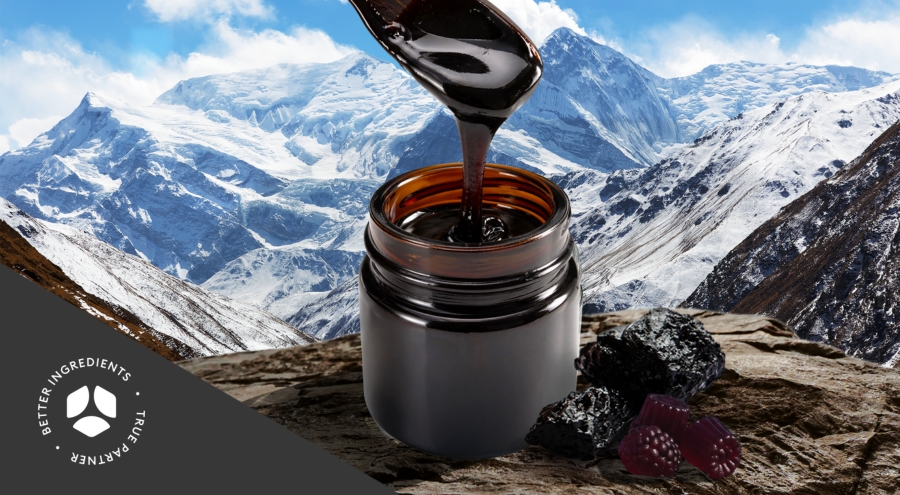
Unlike traditional botanicals that are harvested from leaves, roots, or fruits, Shilajit is a naturally occurring phytomineral resin created through the gradual decomposition and compression of plant material within mountain rock. This distinctive origin gives Shilajit a composition unlike many traditional botanical ingredients used in modern dietary supplements.
In Ayurveda, Shilajit has long been classified as a rasayana, a category of rejuvenative ingredients traditionally used to promote vitality, resilience, stamina, reproductive wellness, and healthy aging. Classical Ayurvedic texts consistently describe purified Shilajit as a rejuvenative ingredient used to support long-term wellness and vitality.¹⁻⁴
Its reputation extends well beyond Ayurveda. Persian, Tibetan, Russian, and Central Asian medical systems have also documented Shilajit as a wellness ingredient associated with strength, recovery, and overall vitality. This broad historical use highlights Shilajit’s longstanding presence across multiple traditional wellness systems.¹⁻⁴
Mitochondrial Function: A Modern Explanation for an Ancient Ingredient
One of the most compelling areas of modern Shilajit research focuses on its naturally occurring dibenzo-α-pyrones (DBPs) and fulvic acid. These two work as a system, rather than as interchangeable parts: fulvic acid binds, protects, and transports DBPs to the mitochondria, where the DBPs can support healthy mitochondrial function. Because the mitochondria are the site of ATP production, the body’s primary source of cellular energy, this relationship may help explain Shilajit’s long-standing reputation as a vitality ingredient. Unlike stimulants that mask fatigue, Shilajit has been studied for its role in supporting the body’s natural energy-producing processes. Mechanistic research suggests that this process may help support efficient ATP production while reducing oxidative stress within the mitochondria. In other words, Shilajit doesn’t just push the system harder. It may help the body’s energy-producing machinery operate more efficiently. ⁸˒¹⁴
Although these findings come primarily from mechanistic and preclinical research, they provide biological context for Shilajit’s long-standing traditional use as a vitality ingredient and complement its historical role in supporting stamina and endurance.¹⁻⁴˒⁸˒¹⁴
Shilajit has traditionally been used as a healthy-aging ingredient, with centuries of Ayurvedic use focused on longevity, vitality, and rejuvenation. Modern mechanistic research gives that tradition a biological footing: the same antioxidant and mitochondrial pathways behind Shilajit’s energy story are central to how cells resist age-related decline.¹⁻⁴˒¹²˒¹³˒¹⁴
This research reaches into the brain, where Shilajit has been studied for potential procognitive activity, and to musculoskeletal wellness, where mechanistic interest in collagen synthesis and extracellular matrix pathways is complemented by human research on bone repair and muscular performance.⁷˒⁹˒¹¹
Taken together, these threads point to a single theme: Shilajit supports several of the key pathways that underlie healthy aging.
One of the strongest areas of published human research focuses on men’s health. Clinical studies have reported improvements in healthy testosterone levels, sperm health parameters, healthy DHEA levels, and overall reproductive vitality following supplementation.⁵
More differentiated, and largely overlooked by the market, is the emerging research in women’s wellness. A randomized clinical trial reported improvements in Female Sexual Function Index (FSFI) scores, supporting Shilajit’s potential role in female sexual wellness, sexual quality of life, and healthy sexual desire and arousal.⁶
Together, these findings open multiple research-grounded directions for product development built on verified composition rather than borrowed claims.⁵⁻⁸
Opportunities for Modern Formulations
Shilajit fits naturally into a broad range of dietary supplement applications, including men’s health formulas, healthy aging supplements, mitochondrial wellness products, musculoskeletal support formulations, women’s wellness products, capsules, powders, gummies, and stick packs.
As consumers increasingly seek ingredients supported by both traditional use and modern scientific research, Shilajit provides brands with opportunities to develop differentiated wellness products across multiple health categories. Its combination of centuries of traditional use, emerging clinical evidence, and distinctive phytomineral composition makes it a compelling ingredient for modern supplement development.
Developing Shilajit Products with NURA
At NURA, we help brands develop differentiated wellness products using authentic Shilajit ingredients supported by technical documentation, formulation guidance, and claims substantiation resources.
Our portfolio includes high-altitude Himalayan Shilajit in both traditional resin and water-soluble powder formats, with fulvic acid standardization options ranging from 20% to 80% to meet a variety of formulation and positioning goals. Every batch is verified for purity, including testing to confirm low heavy metal levels, helping brands formulate with confidence while meeting the quality expectations of today.
Whether you’re developing a men’s health supplement, a healthy aging formulation, or a broader wellness product, our team can help identify the right Shilajit specification and provide the technical support needed to bring your product to market with confidence.

 Back
Back